Quick Summary
1. The short answer: Source:
2. Also covered: Glazed Salmon or Harissa Honey Chicken: which has more protein?
3. Also covered: The difference is more than calories
4. Also covered: How much sodium changes if you swap them?
Table of Contents
- 1. Glazed Salmon or Harissa Honey Chicken: which has more protein?
- 2. The difference is more than calories
- 3. How much sodium changes if you swap them?
- 4. Compare two bowls without changing everything
- 5. What if you are looking for more protein per calorie?
- 6. What about allergies?
- 7. Which one belongs in your bowl?
- 8. Bottom line
1. Glazed Salmon or Harissa Honey Chicken: which has more protein?
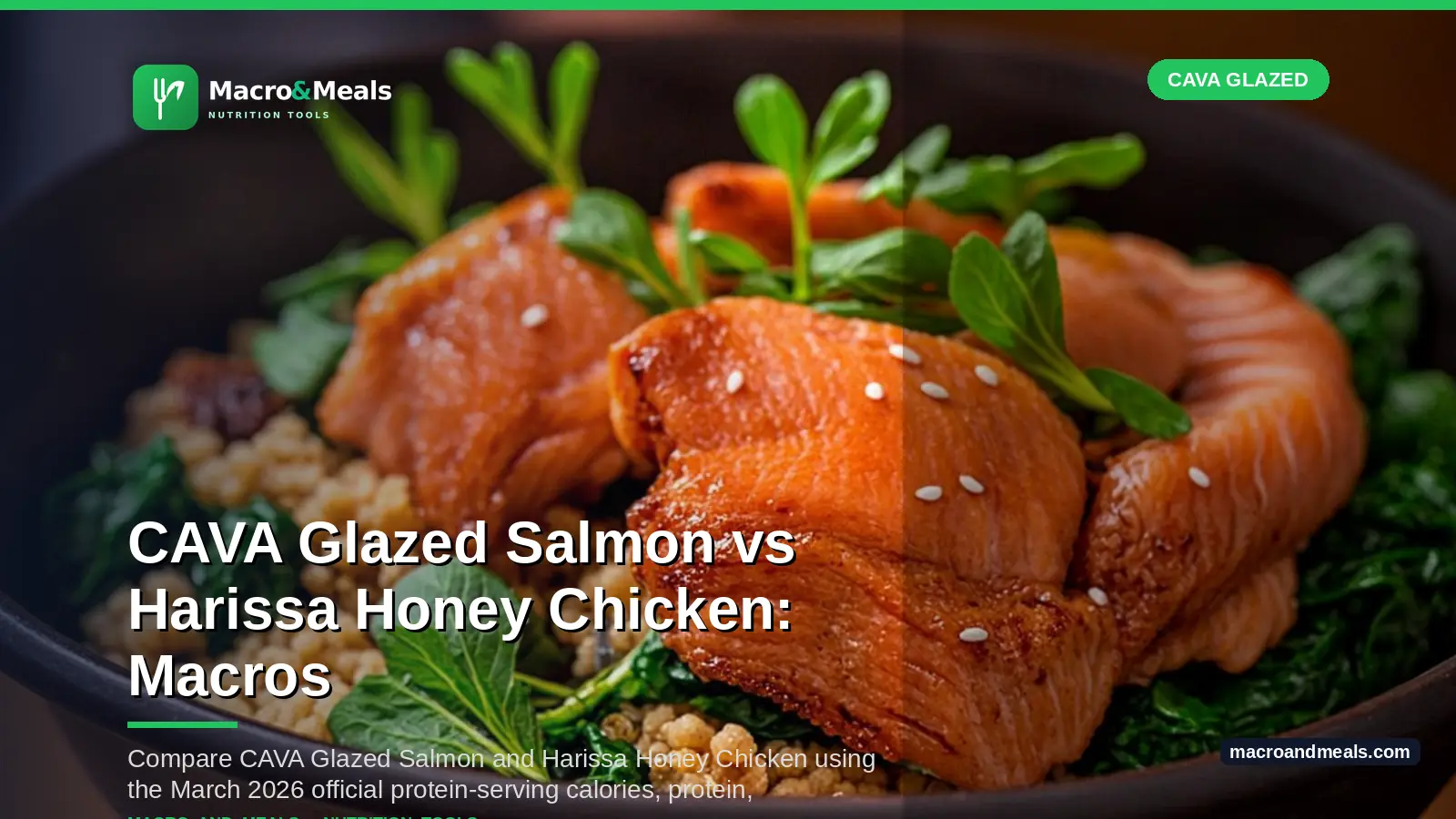
If you are choosing between these CAVA mains primarily by their listed protein grams, Harissa Honey Chicken is slightly ahead. CAVA's March 2026 US Nutrition and Allergen Guide lists 26 grams of protein and 260 calories per standard Harissa Honey Chicken main. Its Glazed Salmon supplies 23 grams of protein and 320 calories per standard main.
That means the chicken offers 3 grams more protein for 60 fewer calories in the restaurant's published standard servings. Salmon may still be the choice you prefer because the ingredients, flavor and fat profile are different. The published guide is a starting point for the decision, not a verdict on which food is “healthier.”
| Official standard main | Glazed Salmon | Harissa Honey Chicken |
|---|---|---|
| Calories | 320 | 260 |
| Protein | 23 g | 26 g |
| Total fat | 23 g | 14 g |
| Saturated fat | 3.5 g | 3 g |
| Total carbohydrates | 5 g | 7 g |
| Dietary fiber | 0 g | 2 g |
| Sugar | 5 g | 3 g |
| Sodium | 630 mg | 670 mg |
Source: CAVA official restaurant nutrition guide, March 2026. These are components, not complete bowls.
2. The difference is more than calories
Looking only at the 60-calorie gap hides a more meaningful distinction. Salmon has 9 grams more total fat in the listed portion, and the two mains differ in fat type and nutrient composition. CAVA introduced Glazed Salmon in April 2026 as its first seafood protein and highlighted its omega-3 fats and vitamin content. Those are relevant considerations, although the announcement alone does not establish how much of every micronutrient a finished bowl delivers.
Harissa Honey Chicken has less total fat and slightly more listed protein, while its name signals a sweet-and-spicy seasoning profile. Neither main is a free pass to disregard the rice, dips or dressing. Your complete meal can change substantially depending on everything else you select.
3. How much sodium changes if you swap them?
The March 2026 guide lists 630 milligrams of sodium for the salmon main and 670 milligrams for Harissa Honey Chicken. That is a 40-milligram difference at the published standard serving size. It is smaller than many people might assume from two different product descriptions.
Importantly, those values are for the mains alone. A bowl with salted grains, pickled toppings and dressing will have a different sodium total. If sodium matters to you, compare the entire order, not just the animal protein. For a medical sodium restriction, follow guidance specific to your situation.
4. Compare two bowls without changing everything
The most informative test is a controlled swap. Start with one bowl containing a chosen base, one dip, two toppings and one dressing. Then keep those items identical while switching only the main from salmon to Harissa Honey Chicken.
Because the rest of the order stays the same, the differences between the complete bowls should mirror the published differences between the mains: 60 calories, 3 grams of protein, 9 grams of fat and 40 milligrams of sodium, subject to restaurant portion consistency and an accurate calculator. This is not a claim that either full bowl contains only 260 or 320 calories.
For instance, if you use brown rice in both orders, do not mistakenly present the salmon plus rice total as the salmon component itself. And if you add Crazy Feta only to the chicken bowl, any final difference will reflect two ingredient changes, not just one.
5. What if you are looking for more protein per calorie?
The published chicken portion contains about 10.0 grams of protein per 100 calories (26 divided by 260, multiplied by 100). The salmon contains about 7.2 grams per 100 calories (23 divided by 320, multiplied by 100). This is a useful comparison method when protein density, rather than absolute calorie intake, is your primary question.
Protein density is not an overall food-quality score. It says nothing by itself about omega-3 content, vitamins, enjoyment or how the meal fits your routine. Both mains can fit into a varied eating pattern.
6. What about allergies?
CAVA's current guide identifies fish and possible cross-contact in shared preparation spaces as relevant concerns following the seafood launch. The company explicitly says it cannot guarantee an allergen-free product. If you have a fish allergy or another serious food allergy, use the restaurant's current allergen guide and speak to staff rather than relying on a comparison blog.
Harissa Honey Chicken and Glazed Salmon should also be assessed separately for recipe ingredients and possible cross-contact. A product's main ingredient is not its entire allergen profile.
7. Which one belongs in your bowl?
If your specific goal is the most listed protein for fewer calories, Harissa Honey Chicken leads this two-item comparison. If you would rather eat seafood and are interested in the nutrient variety salmon brings, the salmon may be a better fit for your preferences. If you are watching sodium, the difference between the two standard mains is relatively small, and the rest of your bowl deserves attention.
Build the two orders in the MacroAndMeals CAVA nutrition calculator. Before relying on the totals, check that it uses the March 2026 protein entries rather than outdated ingredient values. A side-by-side view with identical bases and toppings is the most honest test.
8. Bottom line
CAVA lists 320 calories and 23 grams of protein for Glazed Salmon, compared with 260 calories and 26 grams of protein for Harissa Honey Chicken. Choose based on the whole order and your taste, not just the single number you notice first.
Sources
Check Cava Nutrition First
Use the free Cava calculator to build your order and see the totals before you go.