Maintenance Fluid Calculator
Calculate daily IV fluid requirements using the Holliday-Segar formula for pediatric and adult patients.
Enter Your Values
About the Maintenance Fluid Calculator
This calculator estimates daily maintenance fluid requirements, the amount of fluid a person needs to stay properly hydrated, using the established weight-based method known as the Holliday-Segar formula. It is a tool used in clinical and caregiving settings, particularly for working out fluid needs in children and patients, where getting hydration right genuinely matters.
Because this is a clinical calculation, I want to be clear up front: it provides a general estimate for education and reference, and actual fluid management for a patient must always be directed by healthcare professionals who consider the full clinical picture. With that said, here is how the method works and why it is used.
What maintenance fluid means
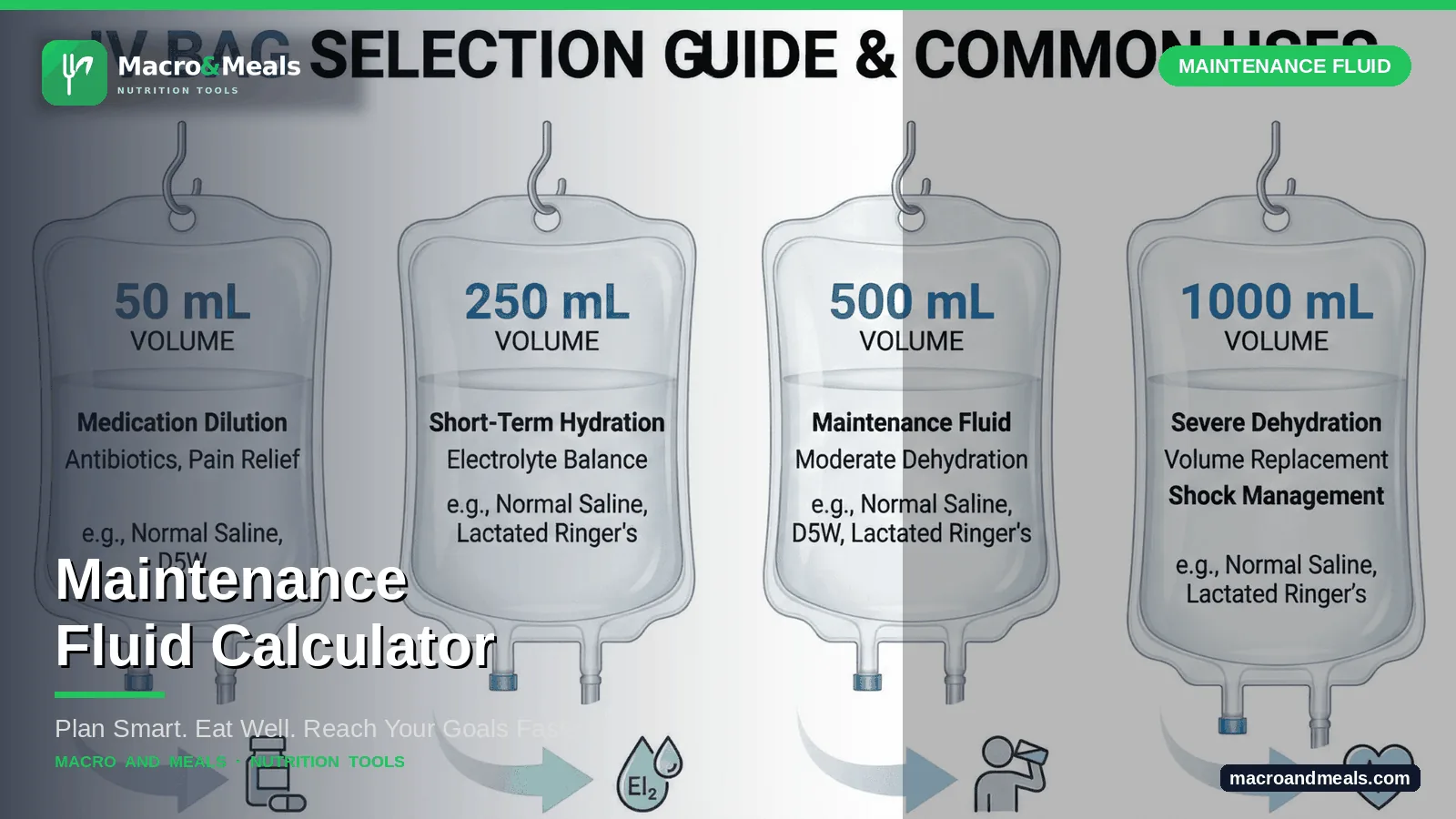
Maintenance fluid is the volume of fluid needed over a day to replace normal losses (through urine, breathing, sweat and so on) and keep the body in balance. It is a baseline for healthy hydration, separate from any extra fluid needed to correct dehydration or ongoing losses from illness. Clinicians use it as a starting point when planning hydration, especially for those who cannot simply drink to thirst.
The Holliday-Segar method
The most widely taught approach is the Holliday-Segar formula, which is weight-based. It allocates a set amount of fluid per kilogram across weight bands: a higher amount per kilogram for the first 10 kilograms of body weight, less per kilogram for the next 10, and a smaller amount per kilogram beyond that. The calculator applies these bands to a person's weight to estimate daily maintenance needs, often used for children but applicable across ages.
Why it is especially used in pediatrics
Children are more vulnerable to both dehydration and fluid overload than adults, and their needs scale closely with body weight, which is why a precise weight-based estimate is so valuable in pediatric care. The Holliday-Segar method has been a clinical standard for exactly this reason. It gives a sensible daily baseline that the care team can then adjust for the child's specific situation.
An important clinical boundary
Please treat this calculator as an educational reference, not a treatment plan. Real fluid management depends on many factors a formula cannot capture: fever, vomiting, diarrhea, kidney or heart conditions, medications and more. In any medical situation, the responsible clinicians determine and monitor fluid needs. Use this to understand the concept, and never adjust a patient's fluids based on a calculator alone.
Sources & method
This calculator uses established, peer-reviewed formulas and reference ranges from recognized health and nutrition authorities. Results are estimates for general education, not a medical diagnosis. For decisions about your health, consult a qualified clinician. Reviewed by Macro & Meals Editorial Team, Content editor.
Frequently Asked Questions
Maintenance fluid is the volume of fluid needed over a day to replace normal losses (through urine, breathing and sweat) and keep the body in balance. It is a baseline for healthy hydration, separate from extra fluid needed to correct dehydration or ongoing losses from illness.
The most widely taught method is the weight-based Holliday-Segar formula, which allocates a set amount of fluid per kilogram across weight bands: more per kilogram for the first 10 kilograms, less for the next 10, and a smaller amount beyond that. The calculator applies these bands to a person's weight.
Children are more vulnerable to both dehydration and fluid overload than adults, and their needs scale closely with body weight, so a precise weight-based estimate is especially valuable. The Holliday-Segar method has long been a clinical standard in pediatric care for this reason.
No. This calculator is an educational reference, not a treatment plan. Real fluid management depends on factors a formula cannot capture, such as fever, vomiting, kidney or heart conditions and medications. In any medical situation, the responsible clinicians determine and monitor fluid needs.