Menses Calculator
Track and predict your menstrual cycle, including period dates, fertile windows, and cycle regularity.
Enter Your Values
About the Menses Calculator
Tracking your menstrual cycle is one of the simplest, most useful things you can do for understanding your body. This calculator predicts your upcoming periods and your fertile and ovulation windows based on your cycle length and the start date of your last period. Whether you want to plan ahead, understand your patterns, or simply avoid surprises, a clear forecast is genuinely handy.
I encourage everyone who menstruates to know their cycle, because it is a real window into your health. The calculator gives helpful predictions from your dates, and I will explain what is normal, what the phases mean, and when changes are worth mentioning to a provider.
How cycle prediction works
Your menstrual cycle is counted from the first day of one period to the first day of the next. The calculator uses your typical cycle length and your last period's start date to project when your future periods are likely to begin, along with your estimated ovulation and fertile days. The more accurately you know your usual cycle length, the better the predictions, which is one good reason to track over a few months.
What counts as a normal cycle
There is a wide normal range. Most cycles fall somewhere between 21 and 35 days, and periods themselves usually last between two and seven days. Cycles can also vary a little from month to month, which is completely normal, especially in the years after first periods begin and approaching menopause. So do not worry if your cycle is not a textbook 28 days; what matters more is what is typical and steady for you.
The phases of your cycle
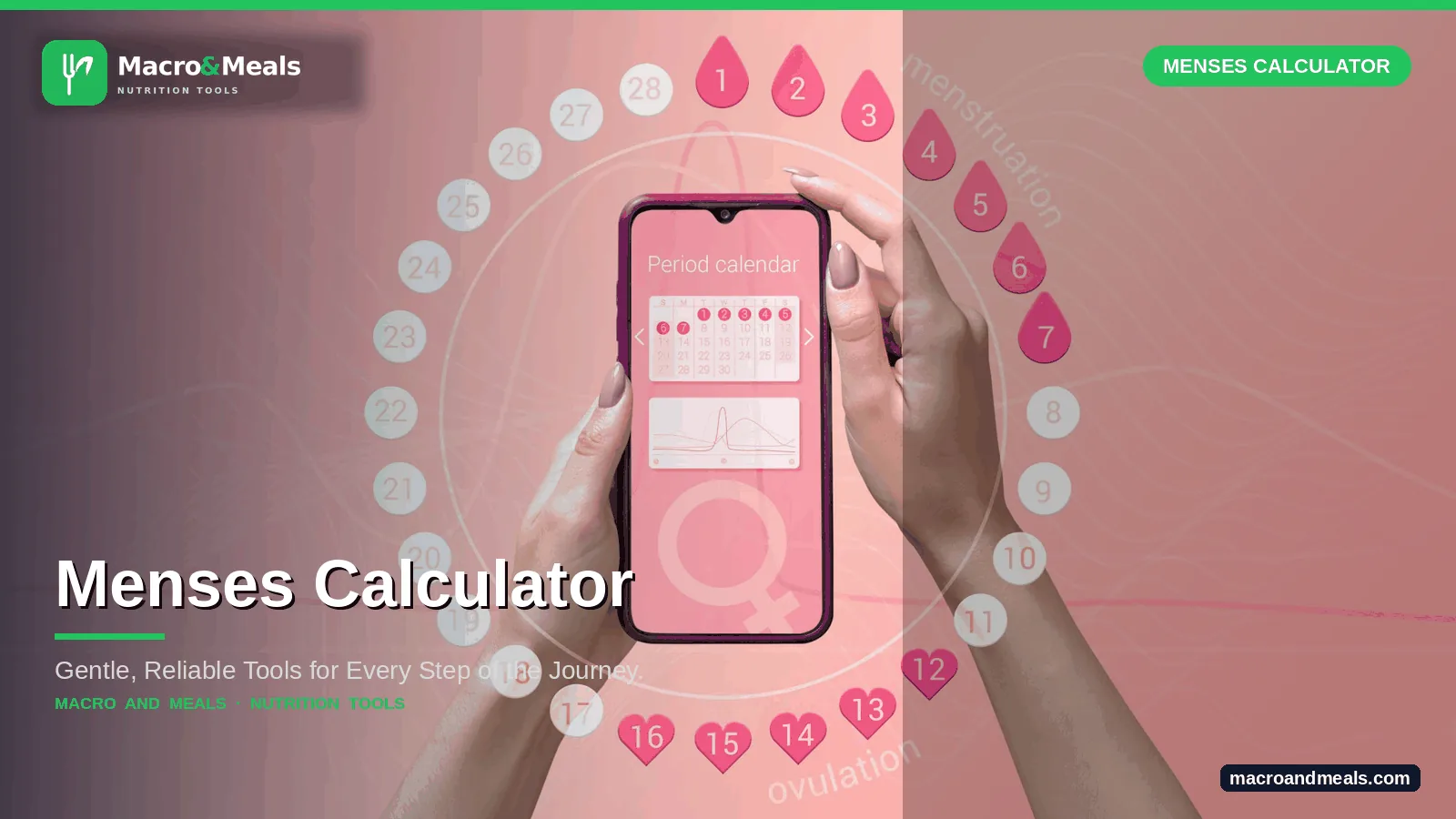
A cycle has a few phases. It begins with menstruation (your period). The follicular phase follows as the body prepares to release an egg. Ovulation, the release of the egg, happens around the middle of the cycle. Then the luteal phase leads up to the next period. Understanding these phases helps make sense of changes in energy, mood and physical symptoms across the month, which many people find reassuring once they see the pattern.
When to check with a provider
Tracking helps you notice changes worth mentioning. Periods that suddenly become very irregular, very heavy, very painful, or that stop unexpectedly (when not pregnant) are worth discussing with a healthcare provider, as are cycles consistently shorter than 21 or longer than 35 days. These are not always a problem, but your provider can reassure you or look into causes. This calculator is for planning and awareness, not diagnosis.
Sources & method
This calculator uses established, peer-reviewed formulas and reference ranges from recognized health and nutrition authorities. Results are estimates for general education, not a medical diagnosis. For decisions about your health, consult a qualified clinician. Reviewed by Macro & Meals Editorial Team, Content editor.
Frequently Asked Questions
It uses your typical cycle length and the start date of your last period to project when future periods are likely to begin, along with your estimated ovulation and fertile days. Knowing your usual cycle length accurately, by tracking over a few months, improves the predictions.
There is a wide normal range. Most cycles fall between 21 and 35 days, and periods usually last two to seven days. Cycles can vary a little month to month, which is normal, especially after periods first begin and approaching menopause. What matters most is what is typical for you.
The cycle begins with menstruation (your period), followed by the follicular phase as the body prepares to release an egg, then ovulation around mid-cycle, and finally the luteal phase leading to the next period. Understanding these phases helps explain changes in energy, mood and symptoms across the month.
If your periods become very irregular, very heavy, very painful, or stop unexpectedly when you are not pregnant, or if cycles are consistently shorter than 21 or longer than 35 days, it is worth discussing with a provider. These are not always a problem, but they can reassure you or investigate.