Quick Summary
1. The short answer: Draining and rinsing canned beans can reduce sodium, though the reduction depends on the product and method.
2. Also covered: What the published study actually measured
3. Also covered: A repeatable rinse method you can use tonight
4. Also covered: How to log drained beans in your recipes
Table of Contents
- 1. Does rinsing canned beans really reduce sodium?
- 2. What did the canned-bean study actually measure?
- 3. Does rinsing wash away the protein and fiber?
- 4. A quick rinse method you can repeat
- 5. Rinsed versus no-salt-added: which makes more sense?
- 6. How to log canned beans after draining
- 7. Is rinsing necessary for every recipe?
- 8. The practical takeaway
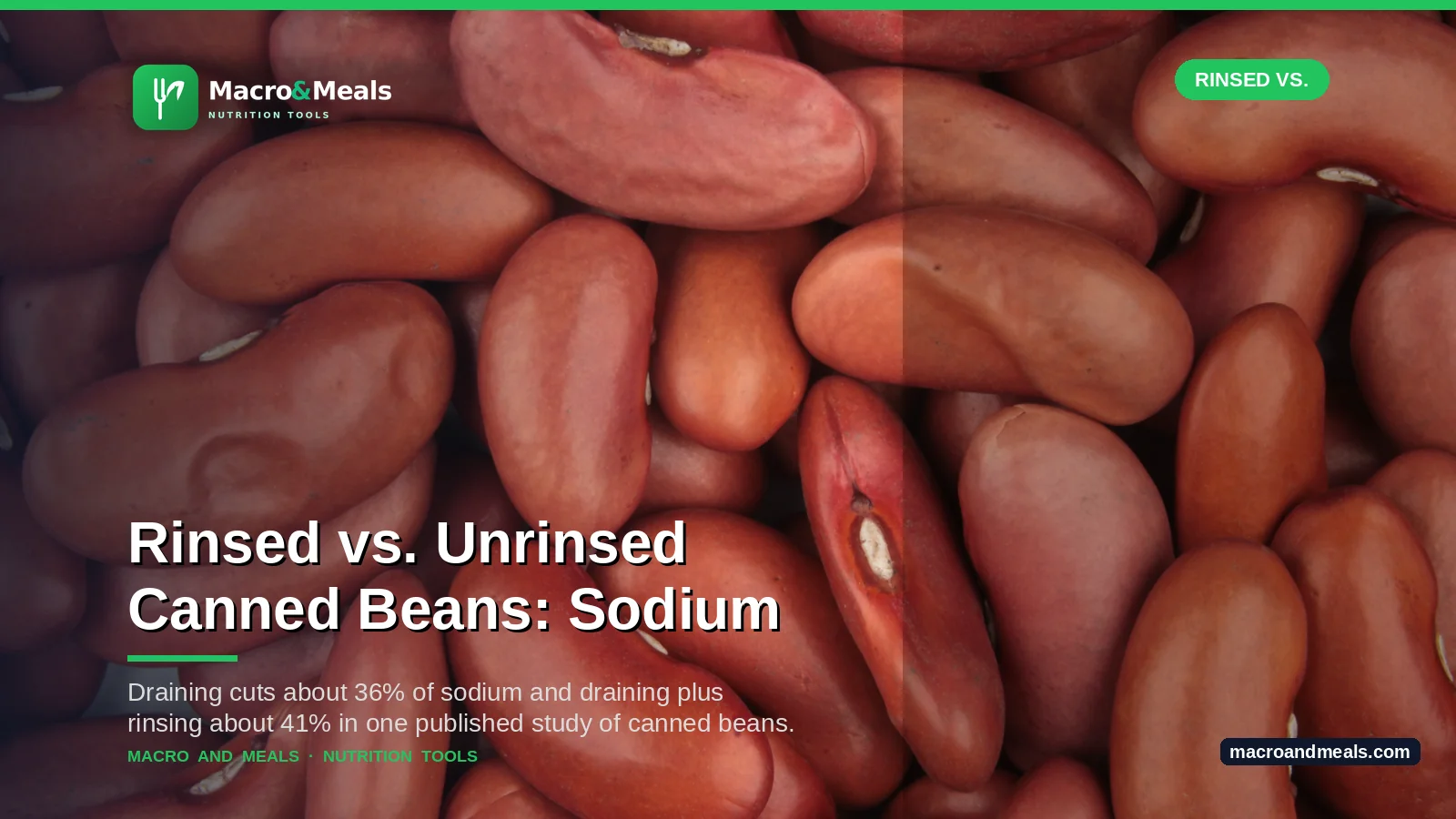
Draining and rinsing canned beans can reduce sodium, although the reduction depends on the product and how you prepare it. A published analysis of five types of canned beans found about a 36% reduction after draining and a 41% reduction after draining and rinsing, under the conditions tested. Those are results from particular products and methods, not a percentage that every can will reproduce.
If you have a can in the pantry and want to make tonight's meal less salty, rinsing is a reasonable, inexpensive step. But you should not automatically multiply the sodium on every brand's label by 0.59 and call that an exact result.
1. Does rinsing canned beans really reduce sodium?
Yes. The size of the reduction is what varies. A study comparing canned beans in their packing liquid with drained and rinsed versions found meaningful sodium decreases, but the starting salt level, the bean type, and the rinse technique all influence the final number on your plate.
That is why a single percentage cannot be promised for every can. The research supports the technique. It does not convert into a universal multiplier you can apply to any brand's Nutrition Facts panel and expect a laboratory-precise result.
2. What did the canned-bean study actually measure?
Researchers compared canned beans in their packing liquid with beans that had been drained and beans that had been drained, rinsed, and drained again. The 2011 study in the Journal of Culinary Science & Technology included multiple brands and five bean types. An Institute of Medicine discussion summarizes the study's average reductions of 36% for draining and 41% for draining plus rinsing.
Notice the comparison: 41% is the reduction relative to the starting canned product under those study conditions. It is not an extra 41% removed after the draining step. That distinction matters when an article promises that rinsing will eliminate nearly all the salt. It will not.
These measurements were published in 2011. Current brands may use different recipes or salt levels. Some cans already contain little added sodium; others use salt in the packing liquid. The finding supports the technique, not a universal current label claim.
3. Does rinsing wash away the protein and fiber?
Rinsing the exterior of a cooked bean does not turn the bean into an empty food. Beans still contribute protein, starch, and fiber after you drain away their liquid. However, some dissolved nutrients can be lost when liquid is discarded or food is rinsed. It would be inaccurate to promise that the only thing you remove is sodium.
Research on canned vegetables has measured losses of some water-soluble vitamins alongside sodium changes. Those vegetable findings should not be silently treated as precise results for beans. What matters for everyday use is that rinsing is a practical sodium adjustment, not a complete nutritional transformation.
If you need exact mineral, vitamin, or macronutrient totals for a specialty diet, compare the relevant manufacturer's drained-bean information or a matching food-composition database entry. A generic canned-bean number may not reflect the portion you actually eat.
4. A quick rinse method you can repeat
- Open the can and pour the contents into a colander over the sink.
- Let the packing liquid drain away. Keep the liquid only if your recipe calls for it.
- Run cool water over the beans, gently stirring to expose the beans evenly.
- Shake the colander and let excess water drain before measuring the beans for your dish.
- Weigh the edible beans if you are calculating nutrition for a recipe.
A rinse that lasts a few seconds will not necessarily match the research method, which is one reason the exact sodium reduction is variable. You do not need to scrub individual beans or treat the preparation as a laboratory test.
5. Rinsed versus no-salt-added: which makes more sense?
If a no-salt-added version is available, compare its actual Nutrition Facts label with the regular product. Buying a lower-sodium product can be more predictable than hoping rinsing a salted product will achieve a particular result.
For example, imagine two cans, one with 400 milligrams of sodium per labeled serving and one with 30 milligrams. Those numbers are hypothetical, not measurements from a particular brand. Even if you use the study's approximate 41% reduction as an illustration, the first can would still represent about 236 milligrams per originally labeled serving before accounting for any serving-weight change. The second may already meet your goal without rinsing.
Do not compare the sodium figures without checking whether both brands define a serving as drained solids, beans plus liquid, or a different gram weight. The serving definition is part of the nutrition claim.
6. How to log canned beans after draining
If your meal uses 180 grams of drained beans, choose a database entry describing canned, drained beans, ideally for your brand. Avoid using the can's total net weight as if it were entirely edible beans. The drained weight is often lower because you have discarded packing liquid.
If the database has no matching drained-and-rinsed sodium figure, you can still log the food while marking sodium as uncertain. You should not claim high precision from a generic reduction factor. For a bean salad with several ingredients, check sauces, olives, cheeses, broth, and salt added during cooking too. Rinsing one ingredient does not determine the sodium of the complete meal.
Try the MacroAndMeals Recipe Nutrition Calculator with the drained bean weight, vegetables, oil, and dressing as separate ingredients. Confirm that the database entry corresponds to the food's prepared state.
7. Is rinsing necessary for every recipe?
No. You might keep the liquid for a dish where it contributes texture, such as a thick stew or a recipe using chickpea liquid as a cooking ingredient. In those dishes, you are keeping the nutrients and sodium present in the liquid too. If you prefer the beans rinsed for flavor or texture, rinse them. If you need the liquid for the recipe, make that a deliberate choice and consider the full dish.
Rinsing is useful, but it is not a judgment on the food or the cook. A well-seasoned bowl of beans can still fit into an ordinary eating pattern. What matters is knowing the variable you changed and avoiding false precision.
8. The practical takeaway
Rinsing canned beans can lower sodium. One measured study found roughly 36% less sodium after draining and 41% less after draining and rinsing, but that does not guarantee the same result for current cans. Compare labels, measure the beans you use, and treat any adjustment to a database's sodium number as an estimate unless it is supported by product-specific testing.
Sources
- Duyff, Mount, and Jones, Sodium Reduction in Canned Beans After Draining, Rinsing (2011): https://www.tandfonline.com/doi/abs/10.1080/15428052.2011.582405
- Institute of Medicine, Strategies to Reduce Sodium Intake in the United States: https://www.ncbi.nlm.nih.gov/books/NBK50952/
- FDA, Serving Size on the Nutrition Facts Label: https://www.fda.gov/food/nutrition-facts-label/serving-size-nutrition-facts-label
Editorial review: A qualified nutrition editor should check the study design and the distinct roles of draining versus rinsing. Do not claim a precise new sodium value for a current brand unless verified, and check that the recipe calculator's bean-entry state matches this guidance.
Calculate Recipes With Drained Bean Weights
Enter drained beans, vegetables, oil and dressing separately for accurate recipe totals.