Quick Summary
1. The short answer: Canned coconut milk used in cooking and coconutmilk sold as a refrigerated beverage are not the same product.
2. Also covered: Compare the products using their own labels
3. Also covered: What happens when you compare the same volume?
4. Also covered: Does the carton mean low fat?
Table of Contents
- 1. Compare the products using their own labels
- 2. What happens when you compare the same volume?
- 3. Does the carton mean low fat?
- 4. What about calcium and vitamin D?
- 5. Saturated fat deserves its own line
- 6. Can you substitute the carton for the can?
- 7. How to log coconut milk in a recipe calculator
- 8. Bottom line
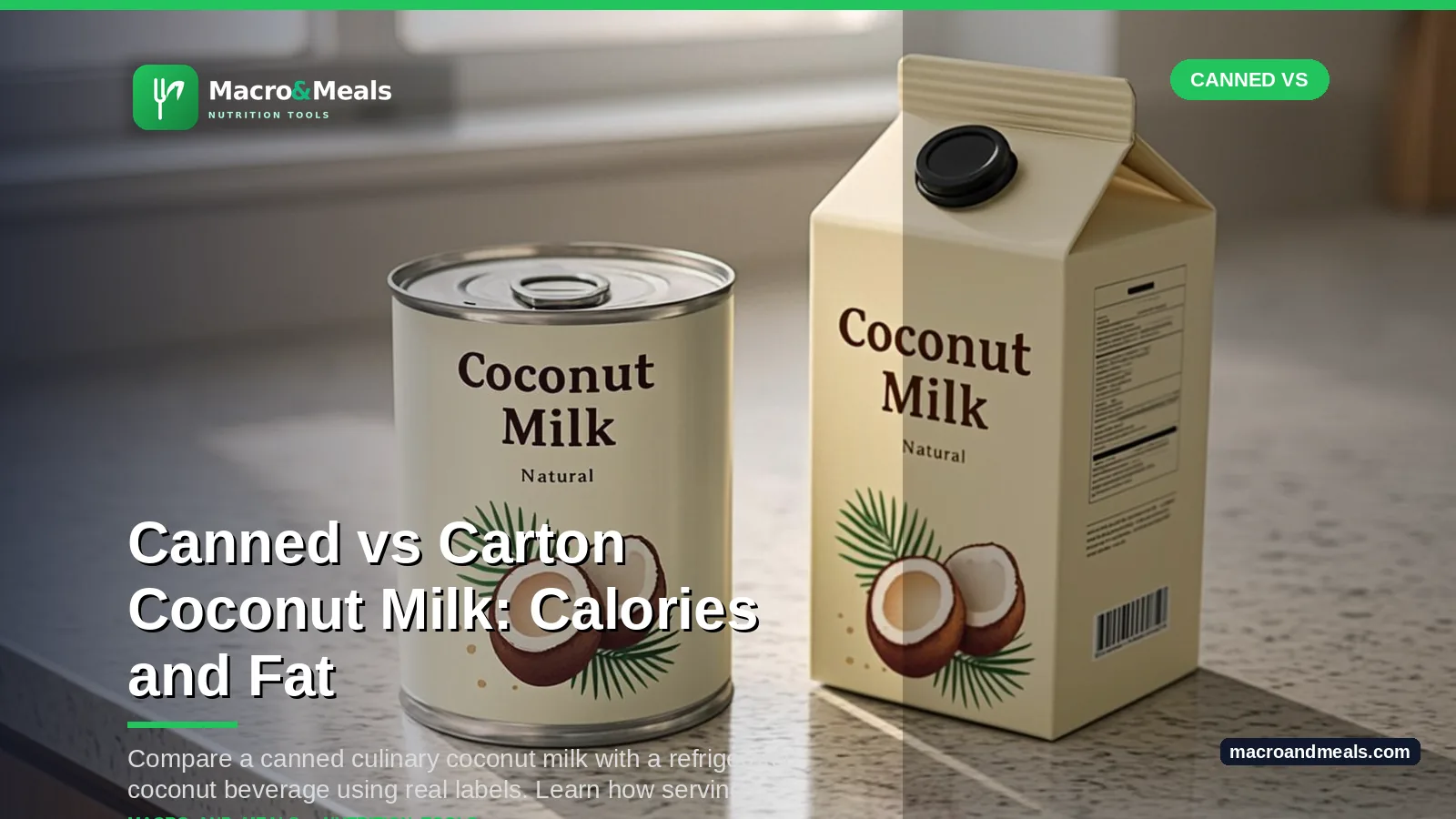
Canned coconut milk used in cooking and coconutmilk sold as a refrigerated beverage are not the same product. One U.S. canned culinary example, 365 Organic Coconut Milk, lists 140 calories and 14 grams fat per 1/3 cup (80 mL). Silk Unsweet Coconutmilk, a beverage, lists 40 calories and 4 grams fat per full cup (240 mL). The serving volumes are different, so simply comparing "140 versus 40" does not compare equal amounts. [1][2]
If you poured canned coconut milk into a curry and logged a glass of coconut beverage, your tracker could be substantially wrong. Start by identifying whether the recipe called for canned cooking milk, canned light coconut milk, coconut cream or a carton beverage.
1. Compare the products using their own labels
| Named U.S. product | Labeled serving | Calories | Total fat | Saturated fat |
|---|---|---|---|---|
| 365 Organic Coconut Milk, 13.5 fl oz can | 1/3 cup (80 mL) | 140 | 14 g | 13 g |
| Silk Unsweet Coconutmilk, refrigerated beverage | 1 cup (240 mL) | 40 | 4 g | 3.5 g |
These are named product labels, not averages for every can and carton. Whole Foods lists ingredients for the 365 canned product as organic coconut, purified water and organic guar gum. Silk's beverage starts with water and coconut cream and includes fortifying vitamins and minerals, stabilizers and sea salt. [1][2]
That ingredient difference is useful context, but the nutrition labels provide the numerical comparison. The phrase "made from coconut" by itself cannot tell you the fat concentration.
2. What happens when you compare the same volume?
Three times 1/3 cup equals 1 cup by U.S. kitchen volume, so the canned 365 values would scale mathematically to roughly 420 calories and 42 grams fat per cup, based on its labeled 80-mL serving. Silk lists 40 calories and 4 grams fat per cup. This is a calculated scale-up of rounded serving-label values, not an independently measured cup of the can. [1][2]
The calculation shows why using the wrong database entry matters. However, coconut milk can separate in the can. If you measure only the creamy top or only the watery lower liquid, the composition may differ from the label's intended representative serving. Stir or shake according to the package instructions before measuring a recipe portion when appropriate.
Also check the can's total servings. Multiplying one serving's rounded value by the stated number of servings gives a labeled package estimate, not a laboratory exact total.
3. Does the carton mean low fat?
The carton beverage is much lower in fat in this particular matched-volume example. That does not mean all carton products have identical values or that the product can replace canned cooking milk in every recipe without changing texture.
Many refrigerated coconut beverages are formulated to be drunk or used in cereal and coffee. They may have more water and added minerals. Canned culinary coconut milk is often selected for concentrated coconut flavor and richness in curry, soup and sauce. A "light" canned variant is yet another product and needs its own label.
If your recipe needs a thick sauce, replacing canned coconut milk with a much thinner drink may produce a different yield and mouthfeel. Those are practical cooking expectations, not claims that we tested a recipe side by side.
4. What about calcium and vitamin D?
Silk Unsweet Coconutmilk lists 470 mg calcium and 4 mcg vitamin D per cup, reflecting its beverage formulation. Its label also lists zero grams protein, zero grams total sugars and zero grams added sugars. [2]
The canned 365 example should not be assumed to contain the same fortification. The specific can label in the cited retail listing shows fat, carbohydrate and protein values but does not supply an equivalent fortified-beverage nutrient story. Don't silently populate absent nutrients with zeros; missing disclosures may simply reflect the label's required fields or underlying formulation.
Fortification may matter if you're comparing drinks, but that is separate from whether a coconut product makes a curry creamy. The best option depends on the actual food use.
5. Saturated fat deserves its own line
The named canned product lists 13 grams saturated fat per 1/3 cup, while Silk lists 3.5 grams per full cup. Both have saturated fat even though they come from plants. Neither coconut origin nor a vegan label makes that figure irrelevant. [1][2]
A reader following clinician-prescribed lipid or heart-health advice should discuss product choice with the appropriate professional. This page can describe the labels and explain portions, but it cannot recommend a personal daily saturated-fat allowance or suggest that a particular plant fat treats a medical condition.
6. Can you substitute the carton for the can?
You can try an ingredient substitution in some dishes, but expect the texture and nutrition to change. The carton example contains much more water per unit of culinary use and a different additive and fortification profile. If a recipe uses a full 13.5-ounce can, pouring in the same volume of refrigerated beverage won't guarantee the same concentration or finished yield.
For original recipe publishing, test the substitution, record the actual amounts and final cooked weight, and measure or calculate the new nutrition from matching ingredient records. Do not claim a soup is just as creamy or tastes identical unless someone actually prepared it.
If you're making coffee or cereal, a thinner unsweetened beverage may be suitable. If you're preparing Thai-style curry, a canned culinary product may be closer to what the recipe writer intended. Neither is a universal nutritional winner.
7. How to log coconut milk in a recipe calculator
Record the exact brand and packaging format first. Use the labeled serving in milliliters or grams, and measure what actually went into your batch. For the canned product, distinguish full-fat and light variants. For the carton, distinguish unsweetened and original sweetened versions.
Next, add all other ingredients and divide the finished recipe by real serving yield. Evaporation changes the final weight and nutrient concentration per 100 grams, but doesn't magically erase the energy from the coconut milk you added.
The MacroAndMeals recipe nutrition calculator should allow these products to appear as separate ingredient choices. If the database has only a generic "coconut milk" entry, that is a reason to verify or correct it, not to silently select the closest name.
8. Bottom line
Canned culinary coconut milk and carton coconutmilk beverage can differ enormously. In two current named U.S. listings, one-third cup of canned 365 Coconut Milk contains 140 calories, while a whole cup of Silk Unsweet Coconutmilk contains 40. Check serving size and product type before comparing or substituting. A food's coconut name cannot replace its specific nutrition label.
Sources
- 365 by Whole Foods Market Organic Coconut Milk, 13.5 fl oz. Labeled 1/3-cup culinary milk values.
- Silk Unsweet Coconutmilk, product nutrition. Labeled 1-cup beverage values.
- Silk coconutmilk product-category explanation. Notes thinner texture compared with traditional cooking milk.
Calculate Nutrition for Any Recipe
Break down your own recipe into calories, protein, carbs and fat per serving.