Quick Summary
1. The short answer: Should I subtract the oil if I drained the can?
2. Also covered: One brand, one drained weight, two packs
3. Also covered: Does draining remove all the oil?
4. Also covered: What if the label says 'per can' instead?
Table of Contents
- 1. One brand, one drained weight, two packs
- 2. Does draining remove all the oil?
- 3. What if the label says 'per can' instead?
- 4. Is tuna in water automatically better?
- 5. How do tuna species and mercury fit into this choice?
- 6. What about macros in a tuna salad?
- 7. Questions worth clarifying
- 8. Bottom line
The word drained is important. If you eat the tuna but pour away the liquid, you should not automatically log the entire weight of liquid that was originally in the can. On the other hand, some oil remains on the tuna after normal draining, and the product's drained-serving nutrition may reflect its own formulation.
1. One brand, one drained weight, two packs
| StarKist Chunk Light 5 oz can | Labeled drained portion | Calories | Protein | Total fat | Sodium |
|---|---|---|---|---|---|
| Packed in water | 113 g | 90 | 20 g | 0.5 g | 360 mg |
| Packed in oil | 113 g | 160 | 20 g | 9 g | 360 mg |
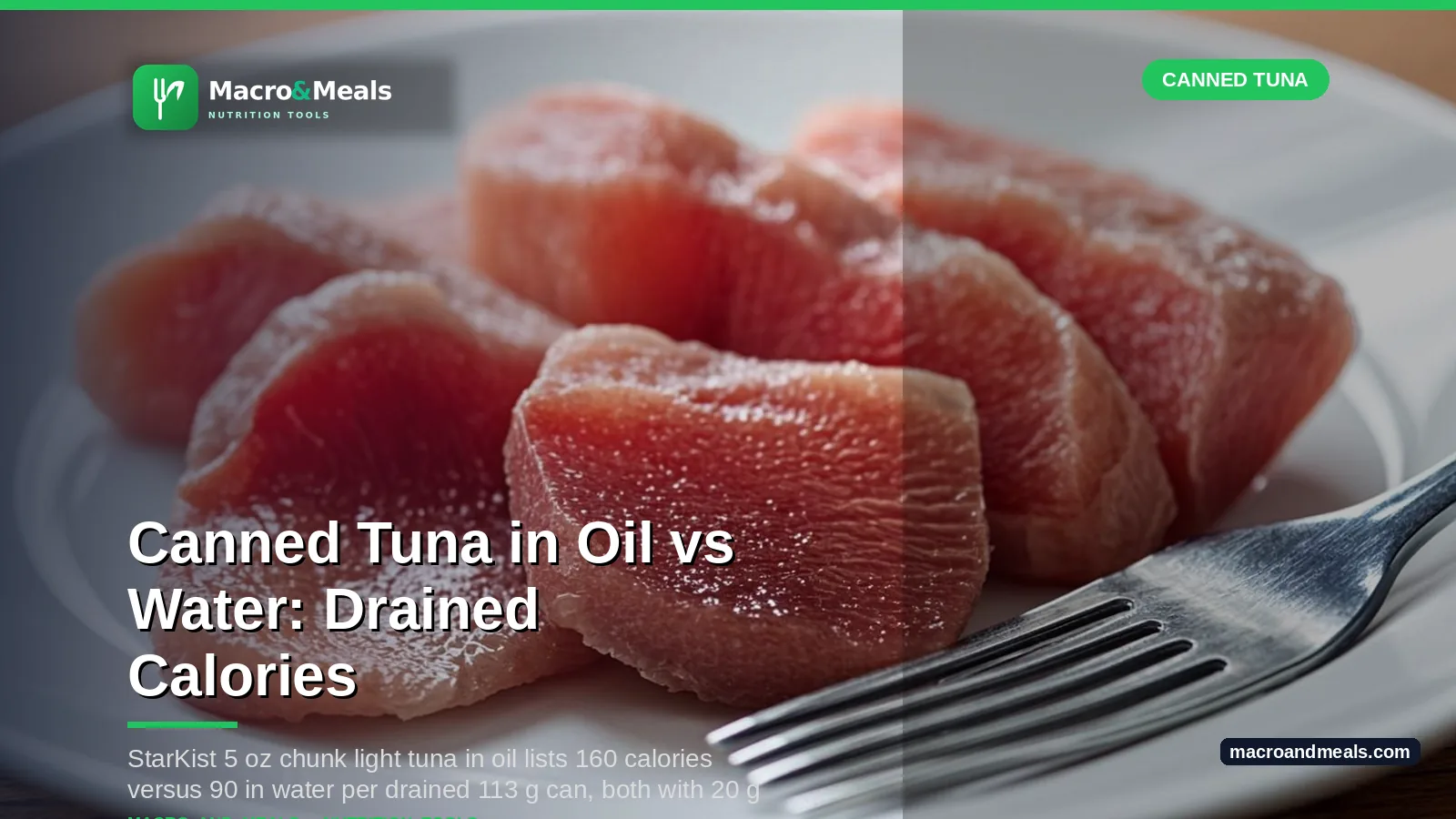
These values are taken from StarKist's current US product nutrition pages. The product pages specify one can drained as the serving. This is a much better controlled comparison than using one company's two-ounce pouch against another company's full can.
At this drained weight, the calories differ by 70 and the fat by 8.5 grams. Sodium and protein are the same on the two specified labels. The difference comes from the product formulations, not because oil magically changes tuna into a higher-protein food.
2. Does draining remove all the oil?
No. You can pour off free liquid, but that does not guarantee removing every bit of oil from the fish. Tuna may absorb or retain packing liquid. More importantly, drained on the manufacturer label is a defined serving condition, not an instruction to subtract arbitrary oil calories from the printed figure.
If a label already gives nutrition for a drained can, use that number for the drained product. Do not take the 160 oil-packed calories and automatically remove 120 calories because you believe you discarded one tablespoon of oil. That would count a guessed reduction that the label may already account for.
If you deliberately pour the packing oil onto bread, pasta or salad, the situation changes. The canned tuna's drained serving is no longer the complete food consumed. You also consumed some or all of the oil. Tracking that extra amount would require measuring it or obtaining a package-level nutrition record that includes the liquid.
3. What if the label says 'per can' instead?
Read the exact words following serving size. A canned product can report nutrition for one drained can, a specified weight of fish, or another form. Two products of the same net can weight can produce different drained weights.
Here is a simple way to check your food log:
- Read the net weight on the outside of the can.
- Read the nutrition label's actual serving amount and whether it specifies drained.
- Check the number of servings per container.
- If you eat the full drained can, log the branded serving accordingly.
- If you use the packing liquid in the meal, account for that separately when reliable information is available.
This workflow is useful for salmon, sardines, beans and other foods packed in liquid, but you should not assume the same retained-liquid fraction across all products.
4. Is tuna in water automatically better?
That depends on what you want. Water-packed tuna is lower in calories and fat in the StarKist example. Oil-packed tuna may have a richer taste or texture that you prefer, especially in a simple salad, toast or pasta dish.
If you are already adding mayonnaise, dressing, cheese or olive oil to water-packed tuna, those additions may narrow or reverse the finished meal's calorie difference. The tuna can is only one ingredient in the plate you actually eat.
Sodium is another common concern. Both selected StarKist cans list 360 milligrams of sodium. Do not assume water-packed always means low sodium. Some specially labeled low-sodium varieties are different products and need their own entries.
5. How do tuna species and mercury fit into this choice?
Packing medium and tuna species are two different decisions. Chunk light is not the same category as white albacore. The FDA and EPA classify canned light tuna, including skipjack, as a Best Choice for the groups covered by their fish advice, while albacore is a Good Choice. Their guidance is especially relevant for people who are pregnant, breastfeeding, might become pregnant, and for children.
This article answers the oil-versus-water question; it does not replace species-specific fish guidance. If that is your main concern, consult the FDA's Advice About Eating Fish.
6. What about macros in a tuna salad?
Suppose you start with the water-packed can's verified 90 calories and 20 grams of protein. Any dressing, crackers, oil or bread comes next. Adding ingredients is straightforward if you have their labels, but guessing dressing amounts often causes more error than choosing between the two tuna cans.
The MacroAndMeals Food Comparison Calculator can help compare exact branded products, and a recipe calculator can combine labeled ingredient amounts for the finished meal.
7. Questions worth clarifying
Should I subtract the oil if I drained the can? Not from a manufacturer figure already labeled one can drained. Use the printed nutrition for the specified serving.
Does the oil-packed tuna have more protein? Not in the matched StarKist example. Both list 20 grams.
Can I use the same numbers for all canned tuna? No. Species, brand, packing liquid and serving definitions vary.
Is 113 grams the total weight of the can? It is the drained serving weight printed on these labels, not the total unopened product weight.
8. Bottom line
In a matched drained-can example, oil-packed tuna adds 70 calories and 8.5 grams of fat while keeping protein equal. The key to accuracy is using the label's stated serving condition, not inventing a universal rule about how much packing oil stays behind.
Sources
- https://starkist.com/product/chunk-light-tuna-in-oil-can/
- https://starkist.com/product/chunk-light-tuna-in-water-can/
Editorial review: Recheck exact package SKU and drained labeling. Research checked October 19, 2026. The draft does not represent a claim that an expert has approved it.
Compare Any Two Foods Side by Side
Put your options head to head and see the numbers that matter.