Quick Summary
1. The short answer: Total plate calories = turkey calories + stuffing calories + mashed potato calories + green bean calories + gravy calories.
2. Also covered: How many calories are on a Thanksgiving plate?
3. Also covered: Start with a portion map
4. Also covered: A straightforward plate calculation
Table of Contents
- 1. How many calories are on a Thanksgiving plate?
- 2. Start with a portion map
- 3. A straightforward plate calculation
- 4. Why turkey numbers differ
- 5. Stuffing and mashed potatoes are recipes, not fixed numbers
- 6. You can build a helpful holiday plate without ranking foods as good or bad
- 7. Safe handling matters more than precise tracking
- 8. What to do with leftover portions
- 9. The takeaway
1. How many calories are on a Thanksgiving plate?
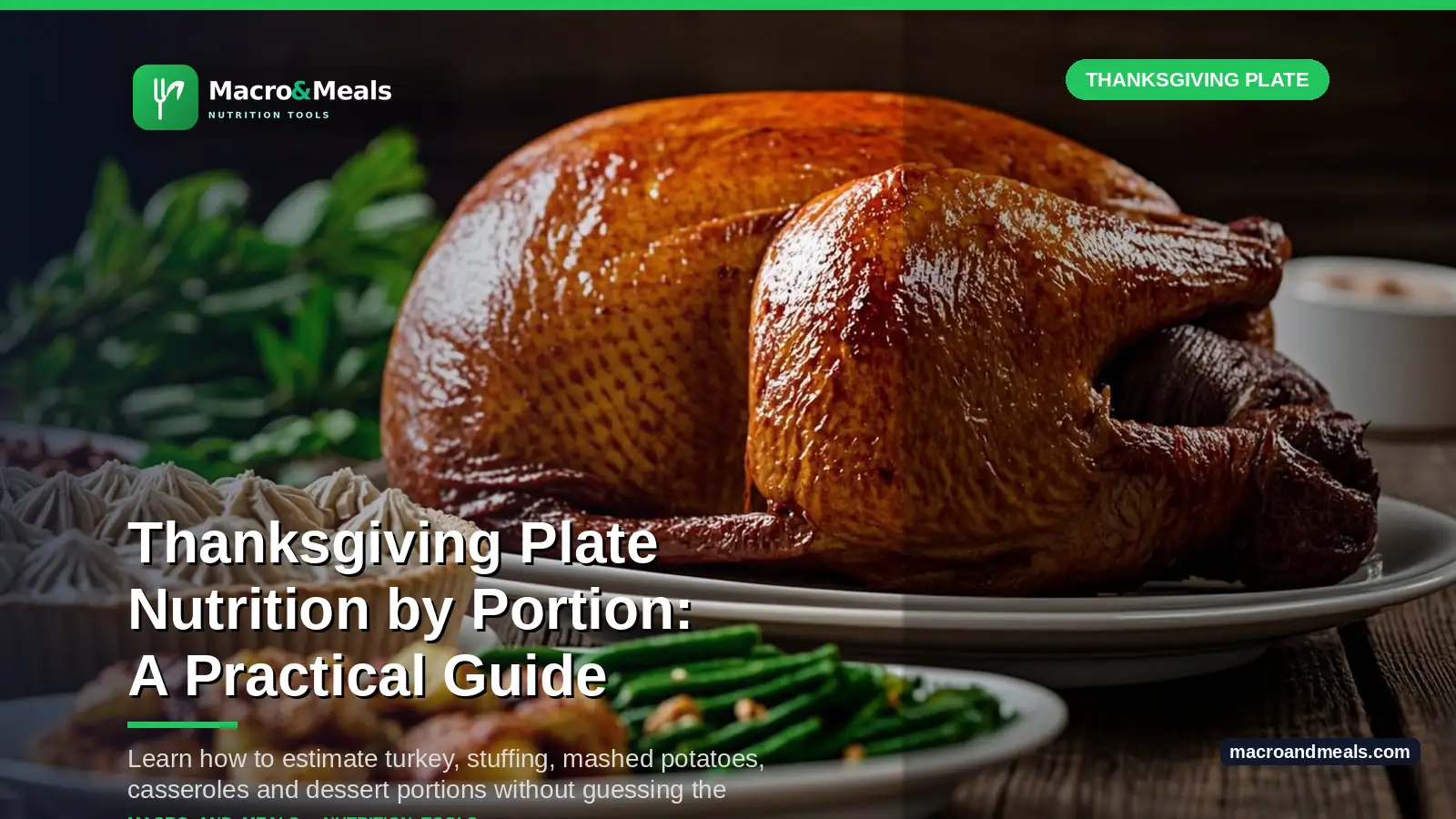
There is no reliable single calorie count for a Thanksgiving plate. Turkey, stuffing, mashed potatoes, gravy, casseroles, bread, and dessert can be prepared in very different ways. Even the same named dish can have a substantially different nutrient profile depending on butter, oil, cream, sugar, and serving size.
A better approach is to break the meal into parts and calculate each recipe's portion separately. That sounds more involved, but it avoids a surprisingly common problem: comparing your family recipe with a generic online number for a different dish.
2. Start with a portion map
Use these portions as measuring examples, not mandatory serving rules or claims about what anyone should eat.
| Food on the plate | Simple way to record your portion | Why the recipe matters |
|---|---|---|
| Roast turkey | Weigh the cooked meat, without bone | Breast, thigh, skin, and added fat differ |
| Stuffing or dressing | Measure cups or weigh a serving | Bread, sausage, butter, and broth vary |
| Mashed potatoes | Measure a serving in cups or grams | Added milk, cream, and butter change the result |
| Gravy | Measure tablespoons or fluid ounces | Some versions have more added fat and flour |
| Green beans | Record plain beans separately from casserole | Casserole sauce and fried toppings add ingredients |
| Sweet potatoes | Measure the prepared dish, not just the raw vegetable | Sugar, marshmallows, and nuts may be added |
| Cranberry sauce | Measure a spoonful or weighed amount | Homemade and canned versions vary |
| Dinner roll | Use the package serving size or weight | Roll size and butter matter |
| Pie | Record the fraction or gram weight of the slice | Crust, filling, and slice size vary |
This approach works whether you are tracking calories for a personal goal, comparing two recipes, or simply curious about how a meal adds up. You do not have to measure every bite to enjoy a holiday. Use the detail that genuinely helps you, and ignore precision that would make the occasion stressful.
3. A straightforward plate calculation
Suppose you are making turkey, stuffing, mashed potatoes, green beans, and gravy. Treat each as a separate item:
Total plate calories = turkey calories + stuffing calories + mashed potato calories + green bean calories + gravy calories.
For each dish, estimate calories per portion from a current food database, a reliable package label, or a complete recipe analysis. Then multiply by the amount actually served. Repeat for protein, carbohydrates, fat, and fiber if those numbers matter to you.
For a homemade casserole, the most accurate practical starting point is the full recipe: record ingredient weights, account for the total cooked yield, and divide the totals by the portion you serve. The MacroAndMeals recipe nutrition calculator can help organize the ingredient-level estimate, provided the entries and yield are checked.
4. Why turkey numbers differ
The term “turkey” is not a complete nutrition description. A skinless slice of roasted breast is different from dark meat with skin. If you search a food database, match the cut, skin, preparation method, and whether the measurement is for cooked or raw weight.
For example, a plate with a few slices of roasted breast and a plate with the same weight of skin-on dark meat are not automatically nutritionally identical. Record what was actually served rather than selecting the first search result named “turkey.”
5. Stuffing and mashed potatoes are recipes, not fixed numbers
Stuffing is often made with bread and broth, but recipes can also include meat, butter, vegetables, fruit, and nuts. Mashed potatoes may contain only milk and seasoning or substantial butter, cream, and cheese.
The most useful question is not “Which number on Google is correct?” It is “Which number describes my version and serving?” When possible, enter the original recipe ingredients. If that is not practical, choose a close database item, label the result an estimate, and avoid decimal-place precision that implies a laboratory measurement.
6. You can build a helpful holiday plate without ranking foods as good or bad
The aim of a nutrition breakdown is information, not a judgment about the meal. If you want a balanced selection, you could include turkey, vegetables, the sides you enjoy, and dessert if desired. If you are managing a medical condition, seek guidance appropriate to your situation rather than assuming a generic holiday plate applies to everyone.
One meal does not describe your entire eating pattern. A useful nutrition guide should make the meal easier to understand, not create a list of foods to fear.
7. Safe handling matters more than precise tracking
The CDC's holiday turkey safety guidance says turkey and stuffing should reach 165°F at the appropriate locations. Refrigerate leftovers within 2 hours of cooking, keep the refrigerator at 40°F or colder, and use cooked turkey and similar leftovers within 3 to 4 days or freeze them. Reheat leftovers to 165°F.
These are practical safety measures for a holiday meal, especially if food is set out for guests or packed for later.
8. What to do with leftover portions
Store turkey, stuffing, and other cooked sides promptly in shallow containers. When you make a leftover bowl or sandwich, count the ingredients in their new quantities rather than carrying forward the entire holiday plate estimate. A spoonful of cranberry sauce in a sandwich is not equivalent to a full serving on the original plate.
9. The takeaway
You can estimate a Thanksgiving plate more realistically by measuring the food you actually serve and using a matching recipe or database entry for each part. Think in terms of ingredients, preparation, and portions. Generic whole-plate calorie totals may be convenient, but they hide most of the details that affect the result.
Sources
- USDA FoodData Central, ingredient-specific nutrient lookup.
- CDC holiday turkey preparation and leftovers, food safety recommendations.
- USDA leftover food safety.
Calculate Nutrition for Any Recipe
Break down your own recipe into calories, protein, carbs and fat per serving.